

In September 2026, registered unemployment in Switzerland edged down, even after seasonal adjustment, according to the State Secretariat for Economic Affairs (SECO). Young people and the over-50s followed suit, but gaps between regions, cantons and industries remain wide.
2 min read
A slight dip on the month
At the end of September 2026, Switzerland had 1,064 fewer registered unemployed than a month earlier (-0.8%), according to SECO. After seasonal adjustment, their number fell by 475 (-0.3%), the first decline since January in SECO's monthly releases. The adjusted rate stayed at 3.1%, its level since May. Seasonal adjustment strips out seasonal effects to reveal the underlying trend, but SECO recalculates the series every month, past values included.
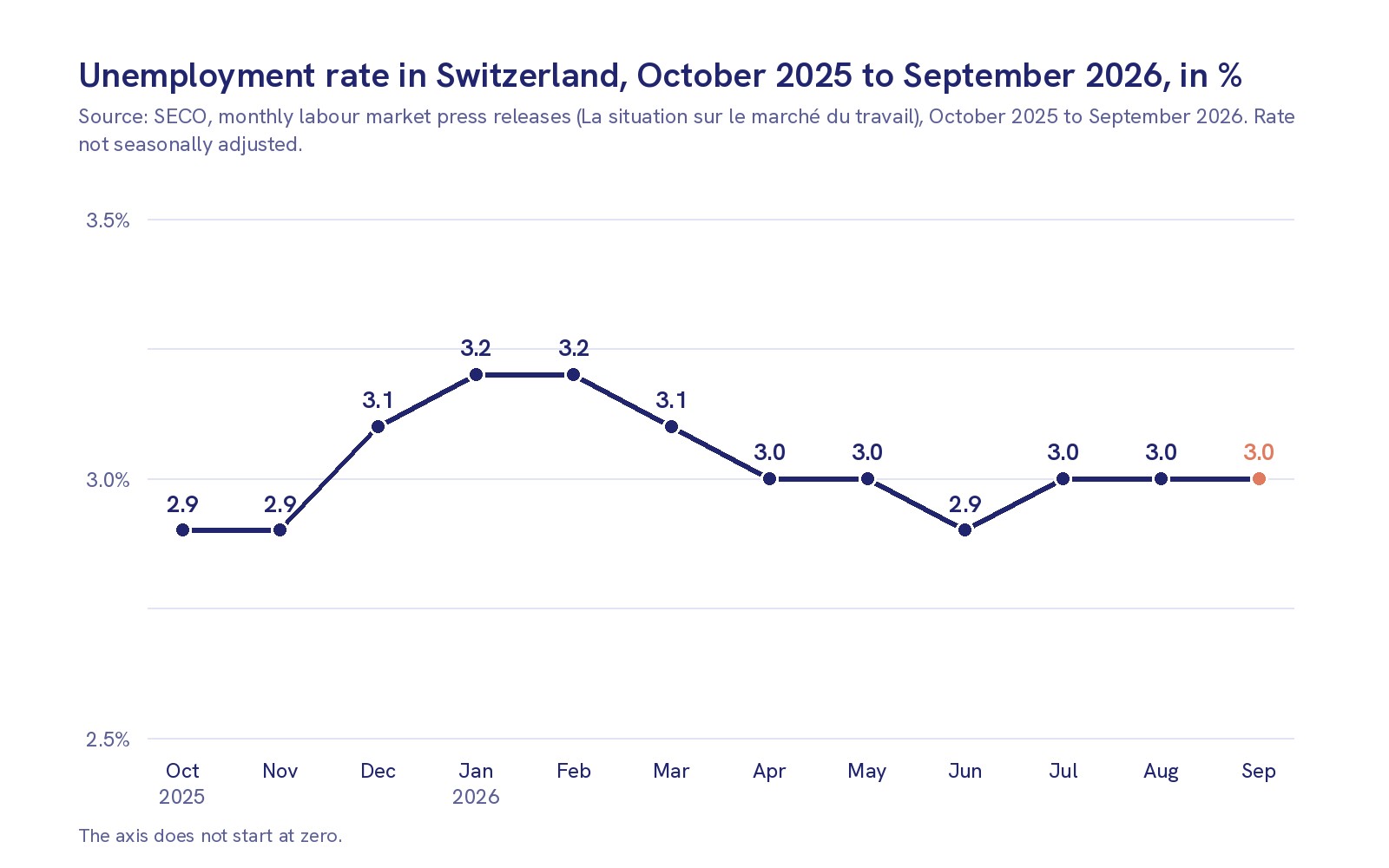
The chart tracks SECO's unadjusted rate since October 2025. After peaking at 3.2% in January and February 2026, it fell back to 2.9% in June and has held at 3.0% since July. Our article on the Swiss job market in 2026 covers the year-on-year trend and the gap with unemployment as defined by the International Labour Organization (ILO).
Age, region and industry
Unemployment among people aged 15 to 24 and 50 to 64, September 2026. Source: SECO.
| Aged 15 to 24 | Aged 50 to 64 | |
|---|---|---|
| Unemployment rate | 3.3% | 2.6% |
| Month-on-month change | -332 (-2.3%) | -201 (-0.5%) |
| Year-on-year change | +485 (+3.5%) | +2,291 (+6.3%) |
| Average time unemployed so far | 2.9 months | 8.9 months |
Among young people, this fall follows a jump in August (+0.6 points, to 3.4%), according to SECO. The Canton of Vaud described the August rise in its own figures as seasonal, driven mainly by young people entering the job market at the end of their training or studies. The over-50s have a lower rate, but the number of unemployed over-50s has grown faster over the year. On average, they have also been unemployed three times as long since registering.
According to SECO, the rate remains at 4.1% for French-speaking Switzerland and Ticino combined, compared with 2.5% in German-speaking Switzerland. Ticino alone stands at 2.9% and, by our calculation, French-speaking Switzerland alone at 4.3%. Geneva has the highest cantonal rate, at 5.3%, ahead of Vaud (4.9%), Neuchâtel and Basel-Stadt (4.4%). Appenzell Innerrhoden has the lowest, at 0.8%. Without the unemployed who receive cantonal or social assistance, SECO notes, the rate would be 0.4 points lower in Vaud and 0.2 points lower in Geneva.
SECO classifies the unemployed by their last employer's industry: those from services are up 9.2% year on year, while those from the industrial sector are down 2.1%. In watchmaking, the fall is 13.2%. In September, the largest increases came from hotels and restaurants (+218 unemployed), followed by health and social work (+148).
What we think
A single month of slight decline is not a turnaround, especially as the adjusted September figure may still be revised. In our view, the market is not closing, but it is not opening up again either. If you have a job and are thinking of moving, this month gives you no reason to wait, and no reason to rush either.
For your job search, your canton, your age and your industry matter more than the national average. If you are registered with a regional employment centre (RAV), look first at the figures for your canton. Better still, follow the job openings in your region: that is the idea behind ApplyNow, which gives you a short list of openings every morning, scored and sorted against your profile. The next figures are due on 5 November 2026, the date SECO has set for publishing its October data.
Sources
- SECO, Secrétariat d'État à l'économie, La situation sur le marché du travail en septembre 2026, 2026-10-06.
- SECO, Secrétariat d'État à l'économie, La situation sur le marché du travail, septembre 2026 (annexe statistique, PDF), 2026-10-06.
- SECO, Secrétariat d'État à l'économie, La situation sur le marché du travail en janvier 2026, 2026-02-06.
- SECO, Secrétariat d'État à l'économie, La situation sur le marché du travail en février 2026, 2026-03-05.
- SECO, Secrétariat d'État à l'économie, La situation sur le marché du travail en mars 2026, 2026-04-08.
- SECO, Secrétariat d'État à l'économie, La situation sur le marché du travail en avril 2026, 2026-05-07.
- SECO, Secrétariat d'État à l'économie, La situation sur le marché du travail en mai 2026, 2026-06-04.
- SECO, Secrétariat d'État à l'économie, La situation sur le marché du travail en juin 2026, 2026-07-06.
- SECO, Secrétariat d'État à l'économie, La situation sur le marché du travail en juillet 2026, 2026-08-06.
- SECO, Secrétariat d'État à l'économie, La situation sur le marché du travail en août 2026, 2026-09-07.
- SECO, travail.swiss, Statistique du marché du travail en Suisse (définitions, FAQ et calendrier), non daté (consulté 2026-10-06).
- SECO, Secrétariat d'État à l'économie, La situation sur le marché du travail en octobre 2025, 2025-11-06.
- SECO, Secrétariat d'État à l'économie, La situation sur le marché du travail en novembre 2025, 2025-12-04.
- SECO, Secrétariat d'État à l'économie, Marché du travail suisse en 2025 : légère hausse du chômage au cours de l’année (indicateurs de décembre 2025), 2026-01-09.
- État de Vaud, Direction générale de l'emploi et du marché du travail, Août 2026: taux de chômage en hausse à 4,9 %, 2026-09-07.
- État de Vaud, Direction générale de l'emploi et du marché du travail, Juin 2025 : le taux de chômage s’établit à 4,2 %, 2025-07-04.
- État de Fribourg, Service public de l'emploi, Chômage à 2,4% dans le canton de Fribourg en juin 2025, 2025-07-04.
- État du Valais, Service de l'industrie, du commerce et du travail, Bulletin statistique, septembre 2026, 2026-10-06.
- République et Canton du Jura, Service de l'économie et de l'emploi, Les chiffres du chômage dans le canton du Jura, août 2026, non daté (consulté 2026-10-13).
- État de Vaud, Direction générale de l'emploi et du marché du travail, Septembre 2026 : taux de chômage stable à 4,9%, 2026-10-06.
- ApplyNow, Outil de recherche d'emploi en Suisse · ApplyNow (page d'accueil), non daté (consulté 2026-10-06).
Published on 14 October 2026, by Greg Lefebvre