

Only four of 32 occupational categories were still facing a shortage in Switzerland in 2025, according to the Adecco Group and the University of Zurich. Yet SECO reports unemployment of at least 5% in some skilled professions.
2 min read
Four shortages, plenty of competition
The 2025 skills shortage index by the Adecco Group and the University of Zurich compares job vacancies with the number of people looking for work. Only four of its 32 occupational categories were still short of staff: health professionals, site managers and supervisors, engineering professionals, and electricians and electronics technicians. Even there, the shortage eased over the year. According to the Swiss Health Observatory (Obsan), nursing was the most advertised occupation in Switzerland, with 8,623 positions posted on 15 November 2024, excluding Ticino.
At the other end of the scale, in occupations with an unemployment rate of at least 5%, employers must report their vacancies, according to the State Secretariat for Economic Affairs (SECO). For the 2026 list, these rates cover the same period as the shortage index. The list is not limited to unskilled jobs: skilled professions appear on it too.
Examples of occupations subject to the job registration requirement in 2026
| Occupation | Unemployment rate |
|---|---|
| Biologists and related professionals | 6.8% |
| Sales and marketing managers | 6.2% |
| Economists | 6.0% |
| Chemists | 5.5% |
| Watchmaking operators | 8.7% |
| Cooks | 5.3% |
Source: SECO, 2026 list; registered unemployment, average from the fourth quarter of 2024 to the third quarter of 2025.
Same field, opposite fortunes
In construction, site managers are still in short supply, but SECO's list gives plasterers an unemployment rate of 10.0%. In industry, welders also play a part, if a smaller one, in the rise in job ads measured by the Adecco Group and the University of Zurich. Yet their unemployment rate is 5.1%. More job ads do not mean less competition: ads for office occupations are rising, but the shortage index found a labour surplus there, as in IT.
SECO groups the unemployed by their last occupation. In September 2026, 28,486 of them came from professional and scientific occupations, 13.3% more than a year earlier. The number from skilled industrial and craft trades, by contrast, was down 5.7% on the year. Even so, unemployment in the first group stands at 2.6%.
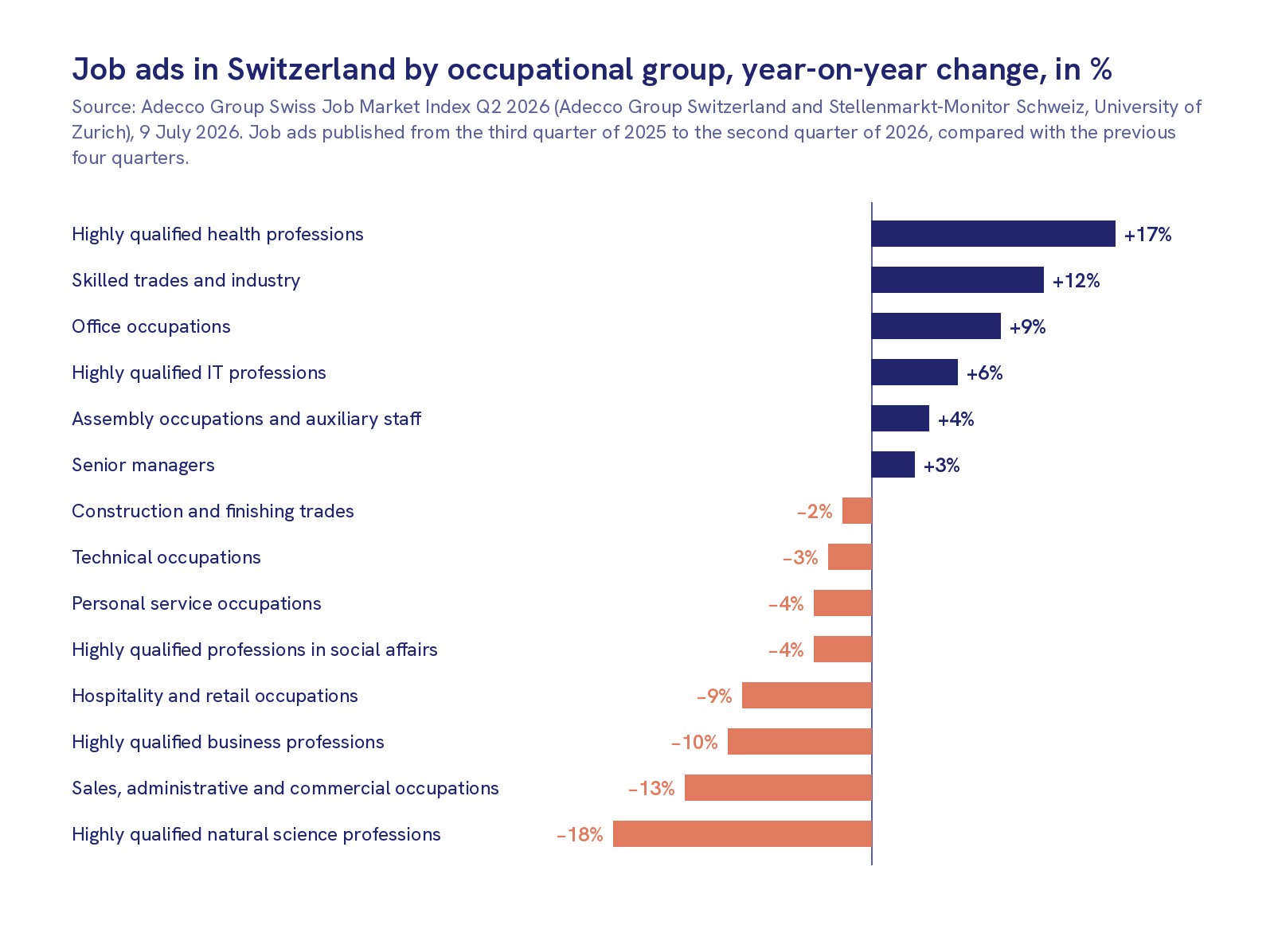
The chart below shows the change in job ads for all fourteen occupational groups in the Swiss Job Market Index of the Adecco Group and the University of Zurich (second quarter of 2026). In IT, ads are picking up slightly (+6%), especially for software developers, but falling for network and database specialists. In office occupations (+9%), the rise comes mainly from general office clerks and secretaries. Our article on the Swiss job market in 2026 gives the wider picture.
What we think
A ranking of occupations tells you where demand is growing, not where you stand a good chance. According to the authors of the Swiss Job Market Index, the effects of artificial intelligence depend less on the occupational group than on the actual tasks a job involves. Whether you are employed or job hunting, look at the specific job, and at other jobs that call for your skills, rather than at a whole occupational family. If you are registered with a regional employment centre (RAV), the Job-Room platform shows you vacancies in occupations on SECO's list five working days before other candidates.
Rather than tracking a national ranking, it pays to follow the vacancies that matter to you: that is what ApplyNow does, with a short list every morning of openings scored and sorted against your profile.
Sources
- Groupe Adecco Suisse et Stellenmarkt-Monitor Schweiz (Université de Zurich), Indice de la pénurie de main-d’œuvre en Suisse 2025 : la pénurie de main-d’œuvre diminue sensiblement en 2025 pour la deuxième année consécutive (communiqué de presse), 2025-11-27.
- SECO, travail.swiss, Obligation d’annoncer les postes vacants et Check-Up pour 2026, non daté (liste en vigueur depuis le 2026-01-01, consulté 2026-10-12).
- SECO, travail.swiss, Genres de profession soumis à l’obligation d’annonce 2026 (liste PDF), 2025-12-01 (en vigueur du 2026-01-01 au 2026-12-31).
- Observatoire suisse de la santé (Obsan), institution commune de la Confédération et des cantons, sur mandat de l'OFSP, Offres d’emploi pour le personnel infirmier (Obsan Bulletin 01/2025), 2025-08 (données au 15.11.2024, état au 01.02.2025).
- SECO, Secrétariat d'État à l'économie, La situation sur le marché du travail, septembre 2026 (annexe statistique, PDF), 2026-10-06.
- Adecco Group Switzerland et Stellenmarkt-Monitor Schweiz (Université de Zurich), Swiss Job Market Index T2 2026 : le marché suisse de l’emploi reste atone, avec des évolutions contrastées selon les groupes professionnels (étude), 2026-07-09.
- Adecco Group Switzerland et Stellenmarkt-Monitor Schweiz (Université de Zurich), Swiss Job Market Index T2 2026 : le marché suisse de l’emploi reste atone, avec des évolutions contrastées selon les groupes professionnels (communiqué de presse), 2026-07-09.
- SECO, travail.swiss, FAQ sur l’obligation d’annoncer les postes vacants, non daté sur la page (consulté 2026-10-13).
- ApplyNow, Outil de recherche d'emploi en Suisse · ApplyNow (page d'accueil), non daté (consulté 2026-10-12).
- Adecco Group Switzerland et Stellenmarkt-Monitor Schweiz (Université de Zurich), Job Index T3 2025, 2025-10-23.
Published on 21 October 2026, by Greg Lefebvre